
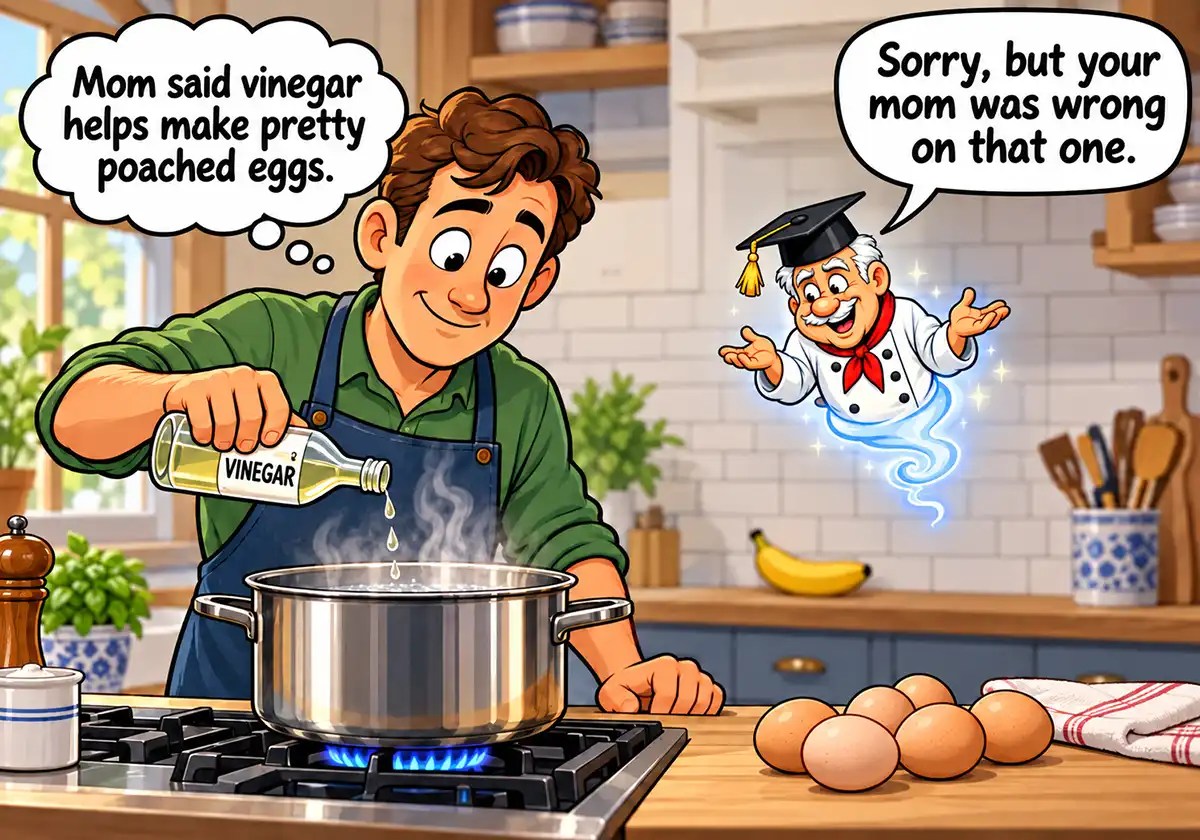
This is a common misconception. Vinegar does not help give you nicely shaped poached eggs. What you need is good technique!
Why Doesn't Vinegar Help?
Eggs set up when their proteins denature, typically when the egg is exposed to heat. It is also true that acids, such as vinegar, can cause egg whites to denature and set up. Thus, some people think that adding vinegar to the poaching liquid will give eggs with a nicer, more compact shape. Nice theory, but it doesn't work. The problem is that acid denatures egg proteins slowly, and by the time the vinegar has an effect the eggs are already set up from the heat. And the vinegar can make the eggs a bit tougher and, of course, add a vinegar taste. Enough vinegar to speed the whites setting up will definitely give sour-tasting egg, so skip the vinegar! What about salt? It has no effect on the cooking but can help the flavor.
Poached Egg Technique That Works
Egg whites have a thinner, watery part that forms the unattractive wispy strands during poaching. By straining this away before cooking, the remaining part of the egg white is much more likely to form a neat attractive oval. Break each egg into a small strainer and let the watery part drain away then transfer the egg to a small bowl, keeping the eggs separate from each other.
Bring 3-4 inches of plain water to a simmer, not a boil. You want small bubbles forming at the bottom with some movement at the surface. Gently slip each egg in, keeping them separated from each other. Cook undisturbed for 3-5 minutes depending on the egg size and degree of yolk runniness you want. Lift out with a slotted spoon and rest the spoon on a paper towel briefly to wick away water. Trim any dangling strands with a small knife or scissors before plating.