Unfortunately this is not true. The term "free range" is essentially meaningless when it comes to the housing conditions of chickens.
What Does Free Range Mean?
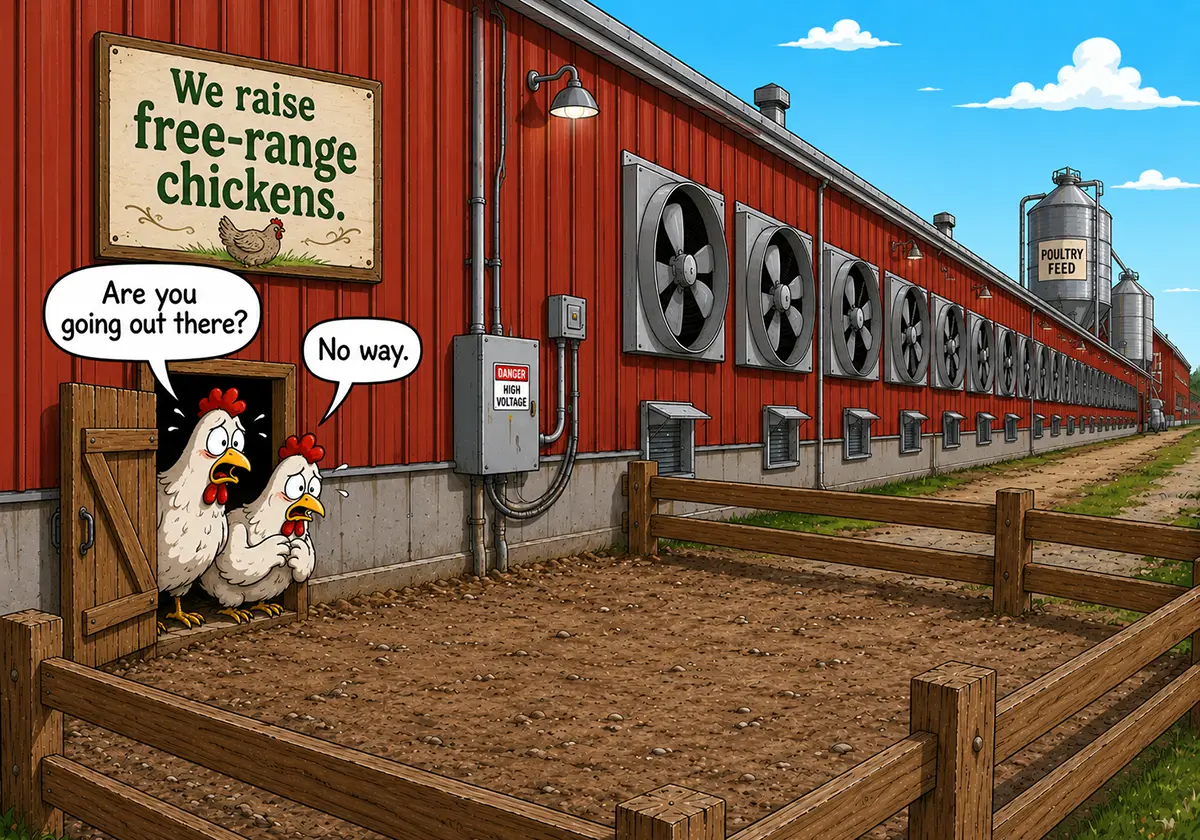
The marketing term "free range" is regulated by the US Department of Agriculture. It requires only that the chickens have access to the outdoors for part of the day. They are not caged but kept in huge crowded barns. There is no precise statutory or regulatory definition of the term and it is decided on a case-by-case basis. The size, quality, or actual usage of the "outdoor area" are undefined. It may well be a small bare dirt area that serves a huge barn with thousands of chickens who rarely or never actually use it. This holds for both chickens raised for meat and for eggs. If you were thinking that "free range" means chickens freely roaming a lush green meadow, think again.
What About "Pasture-Raised" Chickens?
The USDA requires that to be labeled "pasture raised," chickens must spend most of their lives on "rooted vegetative cover," which means outdoor space with grass or other plants—in other words, what could reasonably be considered to be a pasture. But, and it is a big "but," this applies only to chickens raised for meat. Laying chickens, those kept for eggs, are not covered by this regulation. So, the label "pasture raised" really means something meaningful when buying chicken meat. For eggs however it is meaningless, if it is used at all.
Cage Free versus Free Range
The cage free specification is essentially identical to free range with the exception that it does not require access to the outdoors. As explained above, the outdoor access provided by free range is really meaningless because the chickens with rare exceptions do not make use of it. So for all intents and purposes cage free and free range mean the same thing, thousands of chickens kept in crowded conditions in a barn. Not a pretty picture.
Other Animal Welfare Certifications
There are three widely recognized non-government agencies that certify farm animal welfare. Their certifications go well beyond the basics of animal housing and will delve into matters such as population density, time outside, permitted breeds, quality of feed, transport, and slaughter techniques. They deal with many different kinds of livestock, and they are briefly summarized here with specific regard to chickens.
Certified Humane (Humane Farm Animal Care)
Certified Humane, run by Humane Farm Animal Care, is one of the most widely recognized welfare seals on chicken and eggs in U.S. retail. The program bans conventional battery cages and requires birds to be kept in cage‑free housing with specified space, good litter, and environmental enrichment such as perches and objects to peck. For chickens, Certified Humane has different tiers—cage‑free indoor, free‑range, and pasture‑raised—with outdoor access or true pasture only guaranteed when those words appear alongside the logo on the package. All farms are audited regularly by independent inspectors, and slaughter plants must be Certified Humane–approved, which ties the seal to humane handling from barn through slaughter rather than just farm conditions.
Animal Welfare Approved (A Greener World / AGW)
Certified Animal Welfare Approved by A Greener World (AGW) is widely regarded by welfare analysts as one of the most stringent farm certification programs, especially for chickens and other pasture‑based species. For broilers and laying hens, AWA standards require genuine outdoor access and pasture management rather than merely a yard; birds must be able to forage, dust‑bathe, and move freely, with rotational grazing plans to prevent pasture degradation. The program focuses on independent family farms and producer groups, not large integrators, and audits all certified farms annually, plus requires AGW‑approved slaughter facilities to ensure welfare at transport and slaughter stages. Critics note it doesn’t specify a numeric outdoor stocking density, but AGW counters that requiring growing vegetation effectively keeps stocking rates low for chickens.
Global Animal Partnership (G.A.P.)
Global Animal Partnership (G.A.P.) is best known for its 5‑Step welfare rating system and its dominant presence on fresh chicken at Whole Foods Market. For chickens raised for meat, G.A.P. standards start with base and “enriched environment” tiers that ban cages, improve litter quality, and require enrichment; higher steps add mandatory outdoor access, more space, and, at the top levels, pasture‑based living. All G.A.P. chicken farms are audited by independent third‑party certifiers about every 15 months, and recent “Better Chicken” updates introduce breed and growth‑rate requirements to move away from conventional fast‑growth broilers. The Better Chicken Commitment analysis finds that G.A.P. (with its Better Chicken Project add‑on) meets strong housing and breed criteria, though its slaughter standards still lag behind the most demanding welfare policies.
For more details on these organizations and their activities please see the first link in the More Info section at the end of this post
Here Are a Couple of Egg-Related Myths for You!
No, brown eggs are not more nutritious!
But, eggs from farm chickens are!