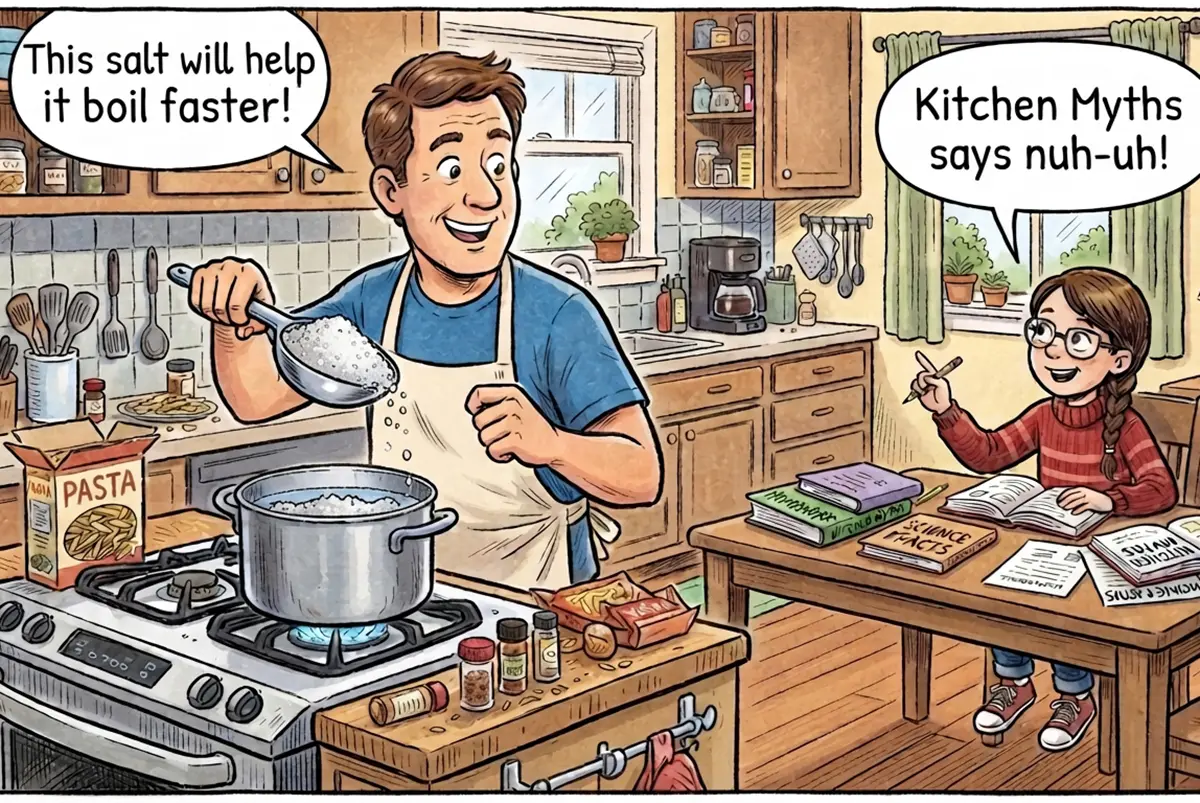
Nay, 'tis not so! But even so, adding salt to pasta cooking water is a good idea.
What Does Adding Salt to Pasta Water Actually Do?
Well, it certainly does not reduce time to boil and in fact increases it a tiny bit. Adding a typical amount of salt will increase the boiling point by a few hundredths of a degree, which is meaningless in practice. Boiling wise, adding salt is irrelevant.
But adding salt to the water is important from a flavor perspective. It allows a bit of salt to soak into the pasta during cooking. This gives better flavor than unsalted water, where the only salt comes later from the sauce which is on the surface of the pasta.

Salting Pasta Water in Italy
Salting the pasta water is a given in Italy. Unsalted pasta water produces pasta Italians call “sciocca,” which means “silly” or “foolish”—a pretty clear statement of how they feel about it. Italian cooking sources often suggest roughly 10 g of salt per liter of water, often expressed as the “1–10–100” rule: 1 liter water, 10 g salt, 100 g pasta. Translated, this is roughly 1 quart of water, 1/2 tablespoon of table salt, and 3-1/2 ounces of pasta. This will be adjusted as needed depending on the saltiness of the sauce to be used.