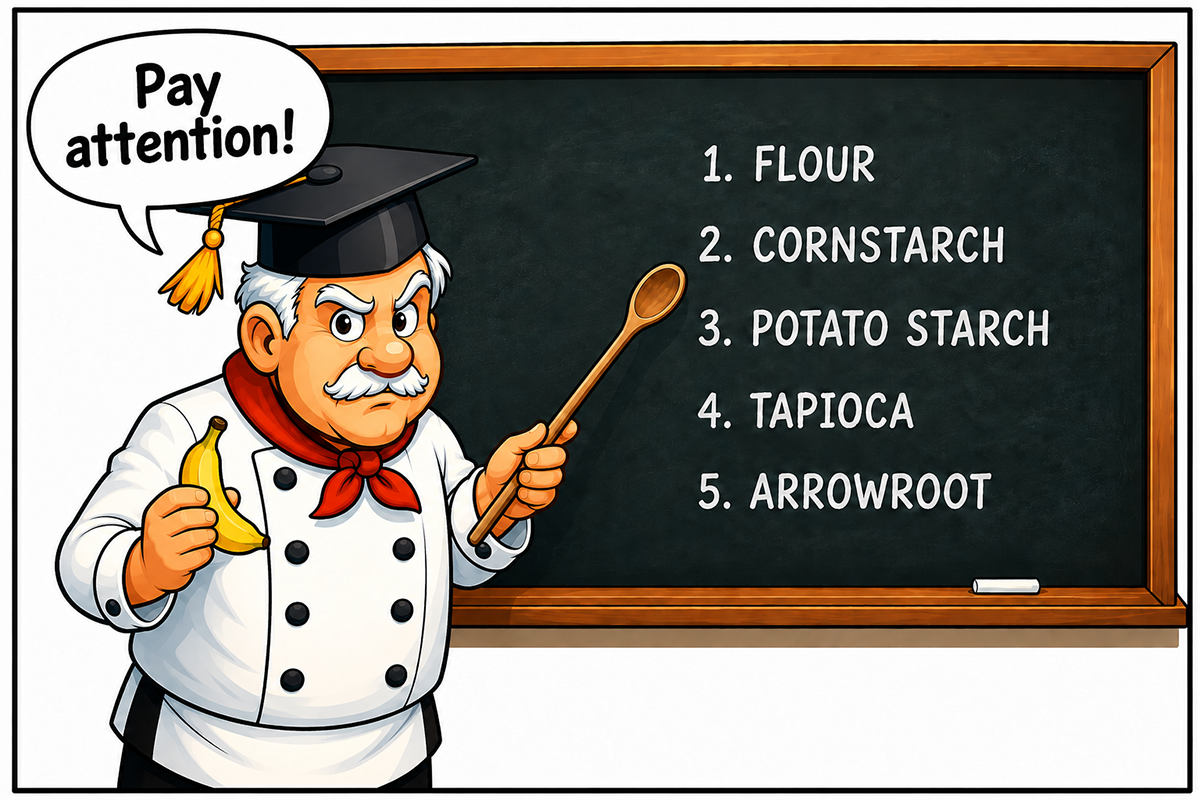
There are five ingredients, all starches, such as flour that are commonly used to thicken stews and gravies. They do not all work the same and it's good for a cook to know the differences.
How Do Thickeners Differ?
A common technique in cooking is to use a starch to thicken a liquid such as a gravy or sauce. Wheat starch (flour) and corn starch are perhaps the most common, but potato starch, arrowroot, and tapioca are also used. Does it matter which one you use? Most definitely. These agents can differ in five ways.
- Strength: How much is needed for a certain thickness?
- Appearance: Is the result cloudy, clear, glossy?
- Heating: Can it take long cooking or high heat?
- Freezing: Can the finished product be frozen and thawed with good results?
- Flavor: Does the thickener add its own flavor to a dish or is it neutral?
Let's look at each of the five commonly used thickeners.
Flour as a Thickener
Flour is perhaps the most commonly used thickener, and is usually cooked in a little bit of butter or fat before the liquid is added. If it is not cooked first, it may impart a floury or "wheaty" taste to the final dish. Liquids thickened with flour are cloudy or opaque in appearance. It is a relatively weak thickener, meaning that it takes more flour than other thickeners to achieve the same results. It can be simmered for a long time without losing its effect, and it freezes moderately well. Flour is the traditional thickener for gravies and stews.
Cornstarch for Thickening
Cornstarch is probably the second most used thickener after flour. It results in a clear appearance and a very smooth texture. Most people find it tasteless, but a few report a subtle corn taste in dishes thickened with cornstarch. It does not react well to prolonged simmering, and therefore is used for quick thickening of pan sauces such as in Chinese stir fries. It is also a popular thickener for pie fillings. Cornstarch's thickening ability may be inhibited by acidic dishes. Cornstarch thickened items freeze fairly well. It does not need to be cooked first, but should be mixed with a little liquid to form a slurry before being added to the pot. You need about half as much cornstarch as flour to achieve the same thickness.
Using Potato Starch
Potato starch is very similar to cornstarch in terms of thickening and other characteristics. It too gives clear, glossy results and is tasteless to most people. Potato starch thickening is activated at relatively low temperatures, should that be an issue for you. Like cornstarch, it does not do well with high heat or prolonged cooking and should be mixed with liquid to a slurry before adding. It freezes well.
Arrowroot for Thickening
Arrowroot falls somewhere between flour and cornstarch in its thickening strength. It gives clear glossy results and is best at lower temperatures, not liking high heat or extended cooking, so it is typically added near the end of cooking. Its texture makes it a good choice for fruit fillings, although it does not freeze as well as tapioca. Also it can lose its thickening effect in dairy-heavy sauces.

What About Tapioca Starch?
This is sometimes sold as tapioca flour. Tapioca gives a glossy, elastic, slightly stretchy finish, making it especially good for fruit pie fillings and baked desserts. Tapioca does best with relatively brief heating. It has excellent freeze/thaw stability, so it holds up well in dishes that will be frozen—like fruit pies! It is tasteless. And yes, this is the same tapioca used in tapioca pudding and in bubble tea.
Summing Up: Thickeners You Need
Most kitchens can get by with having only flour and cornstarch on hand for thickening. If you do pie fillings and things like that, you might add tapioca to that list. Arrow root and potato starch are so similar to cornstarch for thickening that I don't see a need to keep them on hand. In fact, I bought both of them many years ago and they sat unused in my cupboard for years until I finally pitched them out.