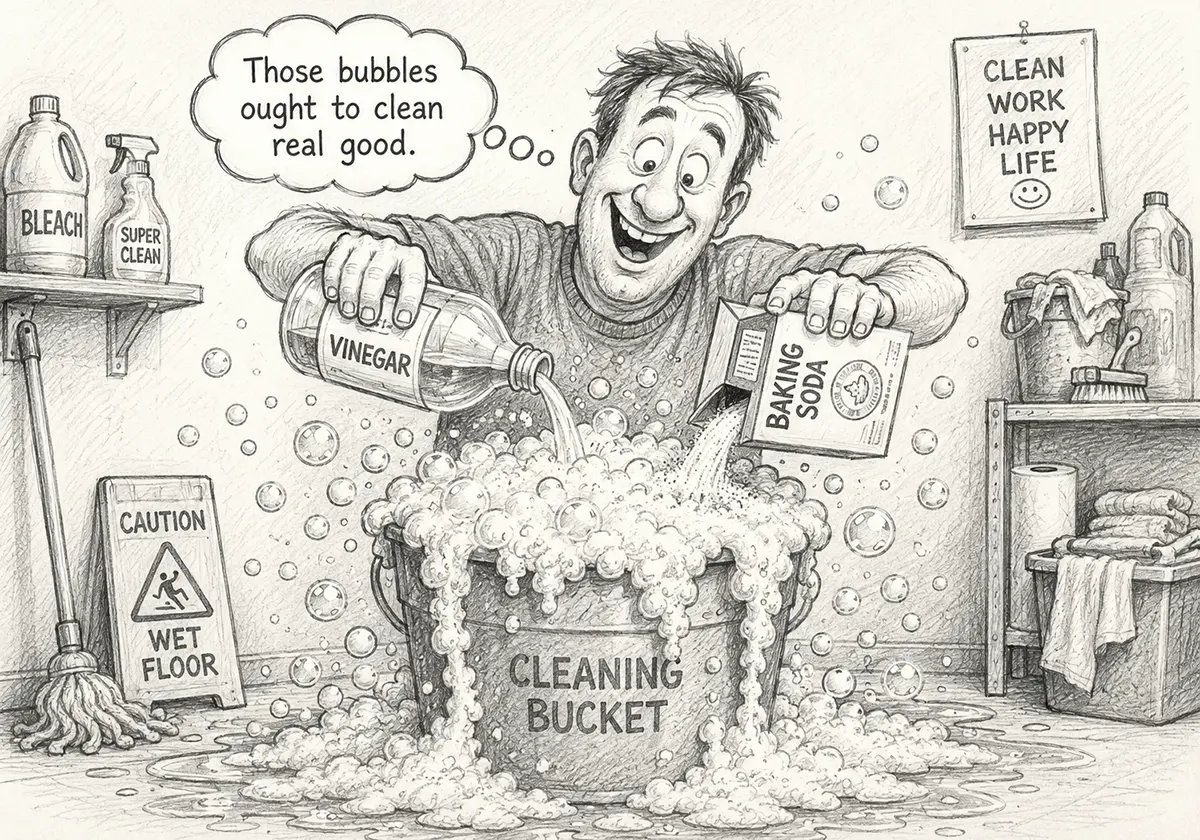
No no no! Individually, baking soda and vinegar have legitimate cleaning uses, but mixing them is a waste of both. A fizzy waste but still a waste!
Why Not Mix Baking Soda and Vinegar?
There's nothing dangerous about it, but it's pointless. Baking soda is a basic compound, meaning that when dissolved in water the pH is greater than 7. Vinegar in contrast is acidic, it is composed of dilute acetic acid and has a pH below 7. When they are mixed, a chemical reaction occurs that neutralizes both of them. The result is carbon dioxide, water, and sodium acetate. The carbon dioxide is what makes the bubbles that cause the mixture to foam up, just like carbonated water. The sodium acetate that remains is just a kind of salt with no cleaning properties.
Why Did This Myth Start?
Baking soda and vinegar are individually very useful cleaners, with very different uses. Vinegar, which has a pH of about 2.4, is useful for hard-water stains, soap scum, and mineral buildup on bathroom fixtures. Baking soda when mixed into a paste with some water is a mild abrasive and can be useful for scouring stainless steel pans, oven interiors and windows, and metal fixtures and utensils. So with two useful cleaners, why not mix them which would be better still, right? And since the mixture bubbles this probably gave the impression of active cleaning going on. Any cleaning that did occur was likely the result of elbow grease!
By the way, never mix vinegar with chlorine bleach because that is dangerous, giving off poisonous chlorine gas.
Some Other Cleaning-Related Myths for You!
Smelly fridge? Forget the baking soda!
Yes, cast iron pans can be cleaned with soap!