

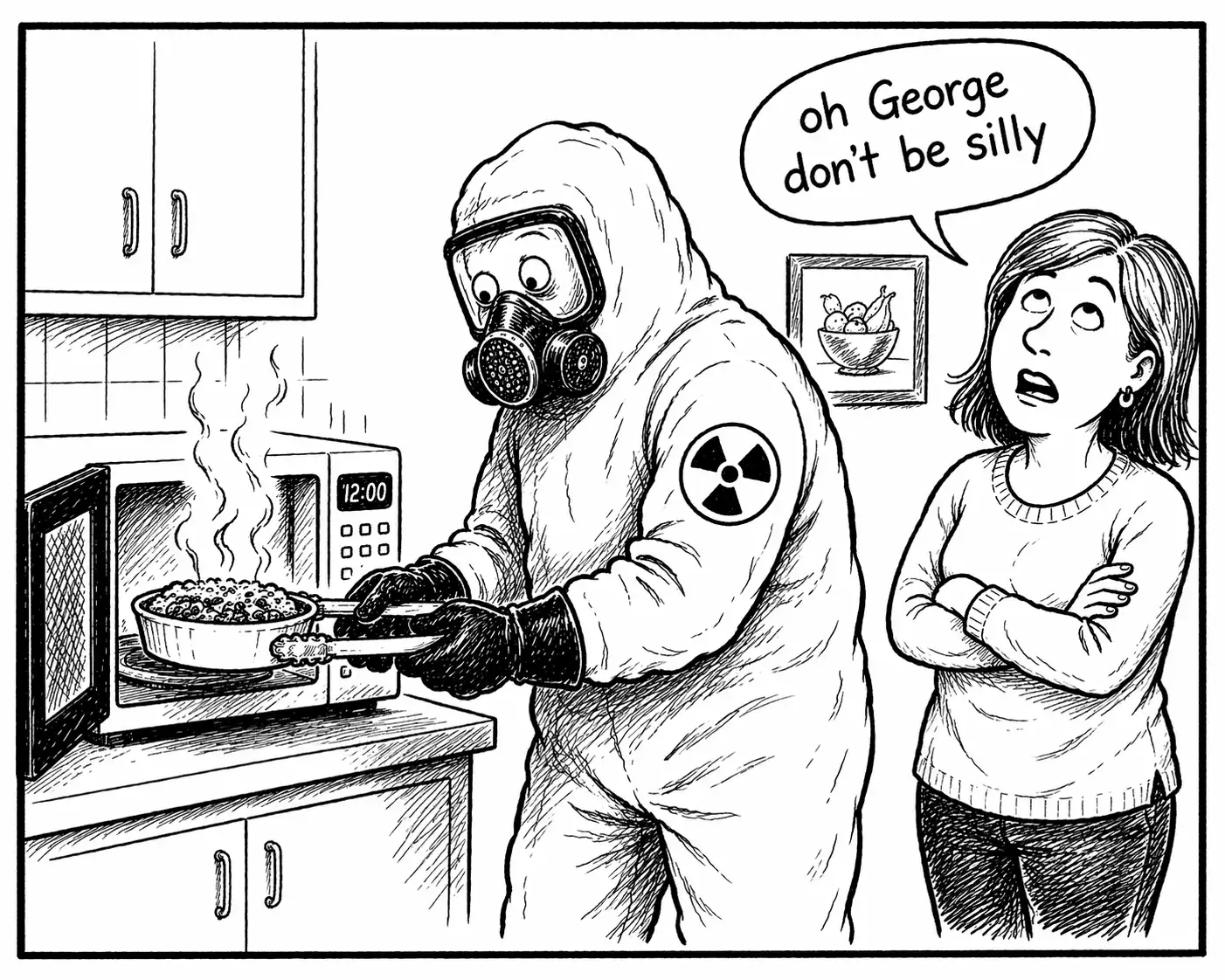
Not to worry. Yes, microwave ovens use radiation to heat your food, but not the dangerous kind of radiation. Microwave ovens are perfectly safe.
Microwave Ovens do Use Radiation to Cook, But...
Microwaves are radiation, but not the ionizing kind of radiation that makes food radioactive, damages your DNA, or causes cancer. Microwave radiation is non-ionizing radiation just like the light from the sun, the warmth from a cozy fire, or the signal that brings you cell phone calls. A microwave oven does not make food radioactive. It simply heats food from the inside out by exciting water molecules, and the oven is designed so the radiation stays contained while the oven runs.
What is Ionizing Radiation?
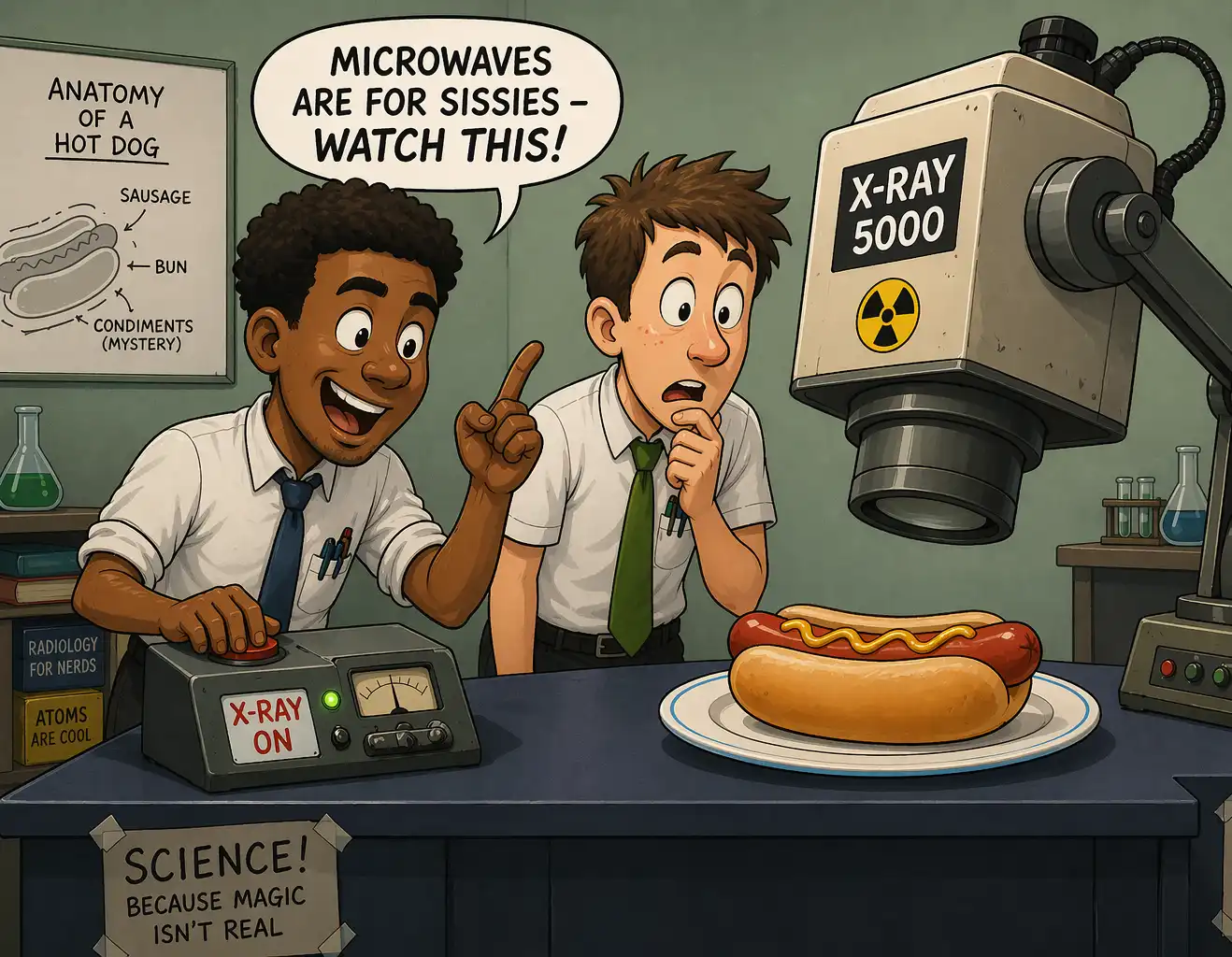
Radiation is called ionizing when it has enough energy to cause damage to molecules such as DNA. The x-rays that your doctor and dentist use are a good example. They are strong enough to penetrate your body and create a diagnostic image, but if overdone they can also cause damage to cells and tissue. This is why you are often given a heavy apron to wear when having an X-ray exam. The apron stops the x-rays and prevents the parts of your body that aren't being examined from receiving the x-ray radiation. Because microwave radiation is much lower energy it cannot cause damage to tissue and molecules beyond heating.


This post is based on the idea that “the ionizing kind of radiation…makes food radioactive” (as it says in the first line), which unfortunately is not correct. Ionizing radiation by definition knocks off an electron; to make something radioactive you need to mess with the nucleus (so affecting a proton or neutron rather than an electron).
Whether microwaves are ionizing or not seems fairly irrelevant here. If it’s ionizing that means it has enough energy to strip an electron, which can form or break chemical bonds and chemically change a molecule. But the whole point of cooking is to make chemical changes to the molecules in food – breaking up some molecules, creating others – often by heat, sometimes by chemical reactions with other ingredients or other techniques. If you used ionizing radiation to make such chemical changes that’d be fine too, and wouldn’t mess with the nucleus in any atoms of the molecules so it wouldn’t have anything to do with radioactivity.
I’m not sure exactly what the myth is here which is being debunked. Is it:
* “Microwaves damage food” — That’s the whole point of cooking, you’re changing the molecules in the food, breaking some apart, joining some, etc.
* “Microwaves damage DNA in the food” — Yes, but so does heating (and brining, marinading, salting, etc), and you’re not trying to have that food grow any more so DNA damage isn’t any more of an issue than damage to any other molecule in the food.
* “Microwaves make food radioactive” — Microwaves don’t even have enough energy to be ionizing, far short of the nuclear transmutation necessary to make something radioactive.
* “Microwaves make food into poison” — Not even specific enough to address directly (exactly what types of poisons are being alleged?); but no, it’s not doing some alchemy which creates chemical poisons out of completely unrelated molecules and elements.
* “Microwaves are radiation” — True, but realize that “radiation” only means “spreading”, they way someone can “radiate” joy when they walk into a room. It doesn’t even say what’s spreading. The sun radiates light, a speaker radiates sound, an antenna radiates radio waves, a fireplace radiates warmth, a car radiator radiates excess engine heat.
From a physics standpoint the only question for any radiation is what the energy level is; if it’s a really high energy level it can mess with the nucleus and make atoms radioactive, if it’s lower but still high energy enough to mess with electrons it can change chemical bonds and reshape molecules and we call it ionizing, and if it’s lower than that energy all it can do is heat the molecules. Electromagnetic waves can be any of these, it only depends on the energy levels — e.g. infrared and microwaves just heat, X-rays are ionizing, some gamma rays can be high energy enough to make something radioactive; note that all of these are “invisible light”, but with different energy levels (some high enough to induce radioactivity!).
Well, as a scientist, thank you for attempting to spread “sweetness and light,” especially light among the great uninformed. However, I didn’t find this post to be one of your best. You repeatedly use the word “radiation,” and then tried to explain the difference by using words like “ionizing.” You have appear to have forgotten when you didn’t know what the word ionizing meant.
A better explanation is that microwaves are a form of light or more generally electromagnetic rays. But in the case of microwaves, the frequency is much, much lower than visible light. And just like the way light, particularly bright sunlight, can heat, microwaves can as well. Microwaves though, invisible, heat by causing molecules to vibrate very, very fast. And one can think of a microwave oven as containing a very bright but invisible form of light.
Though a microwave is said to heat by radiation, the microwave radiation is a form of low frequency light, and not at all the same as particles emitted from a radioactive substance.
Thanks for your comment. I like your analogy of microwaves as “low frequency invisible light” and will try to work that into the post. I think it will get my point across better to some readers.