
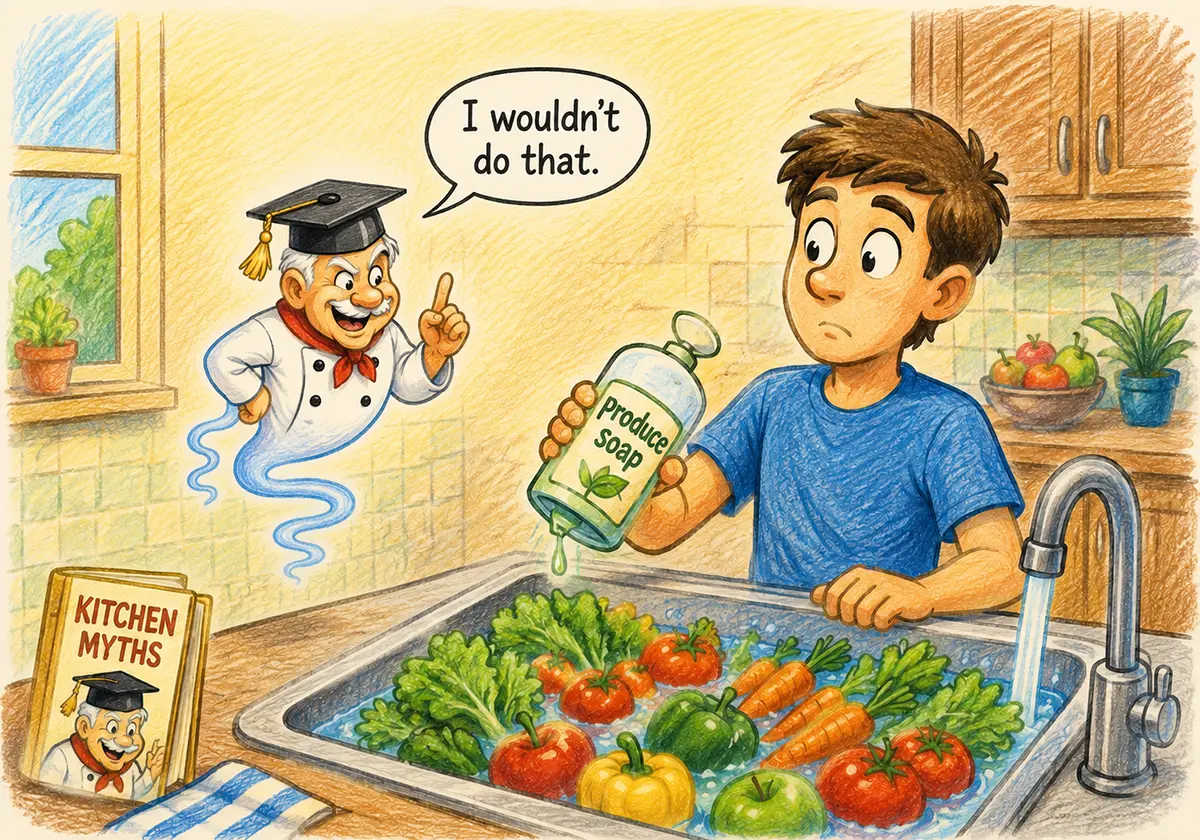
You may see ads for specialized "veggie soaps" for cleaning produce. These products do not work better than plain water and may pose health risks.
What the Science Shows
Studies comparing commercial fruit-and-vegetable washes to plain water consistently find no meaningful advantage for the washes. University of Maine and Tennessee State work, for example, showed distilled or tap water could remove around 90–98% of surface bacteria, matching or outperforming commercial washes. EPA-linked guidance from NPIC similarly notes that produce soaps “are no more effective than water alone” at reducing pesticide residues on the surface..
Safety Concerns With “Veggie Soaps”
Veggie soaps aren’t formulated as foods, therefore their ingredient safety is assessed for skin contact and environmental release—not for routine ingestion. Produce is porous; it can trap soap in microscopic openings in the produce's skins and tissues. Guidance from FDA, National Pesticide Information Council, and multiple food safety experts points out that soap residues can lead to gastrointestinal irritation (vomiting, diarrhea) and may alter gut microbiota if ingested regularly. This is why official recommendations are very clear: avoid soaps, detergents, and unvalidated “produce washes,” and stick to methods intended for food.
Recommended Ways to Wash Produce
The most supported approach is surprisingly simple and free of costs:
- Rinse under clean, cool running water for at least 20–30 seconds, rubbing with hands or a clean brush for firm items.
- Use a dedicated vegetable brush on thick-skinned items (potatoes, melons, cucumbers) to physically dislodge dirt and microbes.
- For nooked-and-crannied produce (broccoli, leafy greens), soak briefly (1–2 minutes) in cool water, agitate, then rinse.
- Dry with a clean towel or paper towel to remove additional residues and moisture where microbes can persist.
Several sources also note that a dilute vinegar solution (e.g., about 1:3 vinegar to water) followed by a good rinse can help reduce bacteria somewhat more than water alone, as long as flavor and texture are acceptable. Baking soda solutions also show modest benefits for some pesticide residues, again followed by thorough rinsing.
Some Other Myths You Might Like!
Smelly fridge? Forget the baking soda, it doesn't work.
Soap to clean cast iron is okay! Yes really.