
Despite the reported experience of many parents, this myth has been been conclusively disproven.
Sugar Does Not Cause Hyperactivity
The notion that consuming sugar causes hyperactivity in children has been around since 1922 and many parents will swear that it is true. However, numerous scientific studies have shown it to be false. The few studies that seemed to support the sugar-hyperactivity connection have been discredited as having methodological flaws and/or alternative explanations of the results. The evidence that sugar intake is not linked to hyperactivity is substantial and incontrovertible. This does not mean that your or other parents’ experiences are false, just that there are other explanations at work.

Origin of the Myth
The idea that there might be a connection between sugar and behavior started in 1973 when allergist Benjamin Feingold proposed that certain food ingredients could contribute to children’s hyperactivity. His book Why Your Child Is Hyperactive exposed a large audience to the notion that diet could influence behavior. Ironically he did not propose sugar as a cause but rather suggested artificial colors, flavorings, other additives, and naturally occurring salicylates. But candy, soft drinks, and other sweet processed foods often contained the additives he criticized. Parents increasingly associated those foods’ sugar content with the behavioral effects being discussed. In the public mind the link became one between sugar and hyperactivity even though Feingold never suggested this— and as we will see, such a link does not exist.
What Does the Evidence Say?
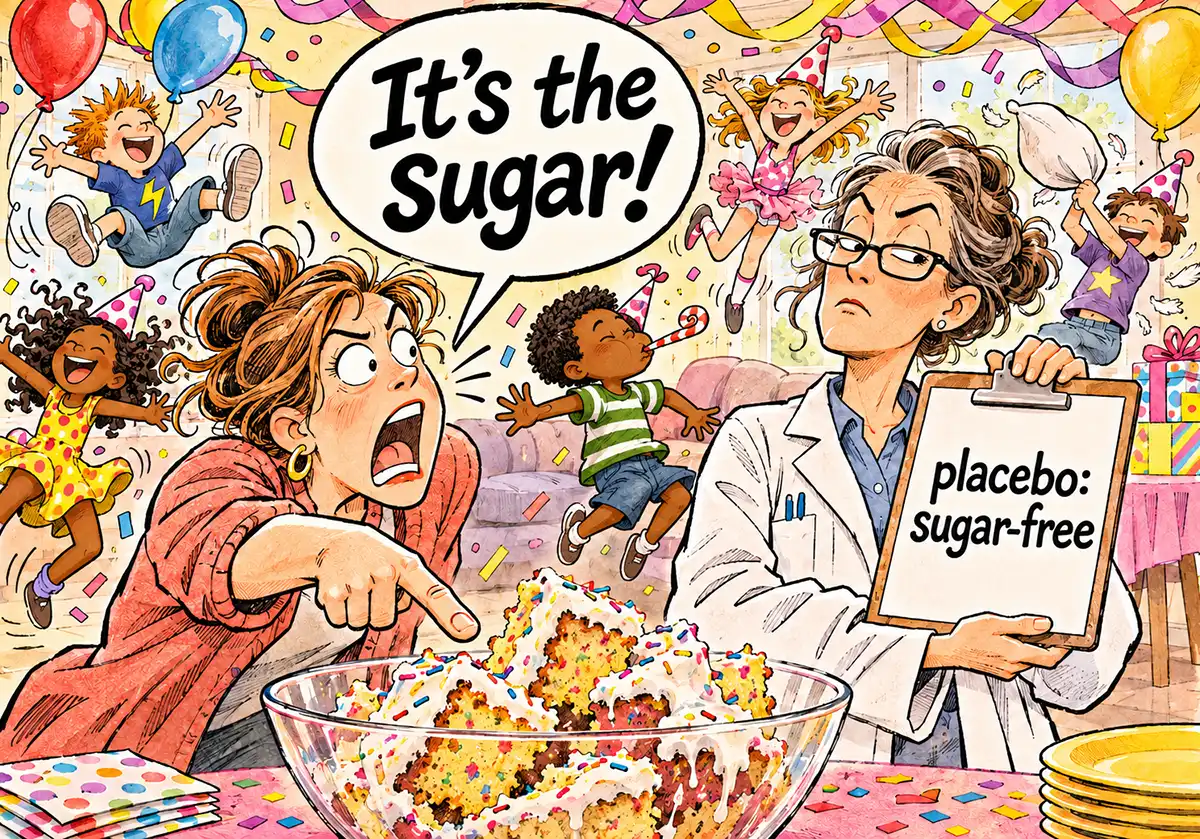
The best experimental evidence leaves no doubt that sugar does not make children hyperactive. Here are blinded studies—where children, parents, and researchers do not know whether the child received sugar or an artificial sweetener. The results have been very consistent: sugar has not increased activity or impaired attention.
The results of 23 studies were summarized in a meta-analysis published in the Journal of the American Medical Association. All were within-subject studies, meaning children were compared with themselves under different conditions. The studies had to use a known sugar dose, a placebo sweetener, and blinding of children, parents, and research staff. Sugar had no significant effect on any of 14 categories of behavioral and cognitive outcomes. This report is linked below.
Why Does the “Sugar Causes Hyperactivity” Belief Persist?
There are perfectly good reasons why so many parents continue to believe this myth. They are not lying or intentionally making stuff up. These are some factors that operate to reinforce the sugar-hyperactivity myth:
- Situations where kids are likely to consume excess sugar, such as birthday parties, vacations, and holidays, are also when children's excitement runs high and rules may be relaxed. Adults may quickly but falsely blame the sugar.
- Parents who believe or have at least heard of the sugar-hyperactivity link may see hyperactivity when it does not really exist after their child has eaten sweets. Parents who think their child has had sugar often report hyperactivity when in fact no sugar has been consumed.
- Kids pick up cues from their parents and may act up to meet their parents' apparent expectations after eating sweets.
While hyperactivity is not a valid concern with sugar intake, there are still reasons to limit your child's sugar intake, such as weight and diabetes.