The Paleo diet is a fad that hit the food world not too long ago. While it has some good points from a health perspective, the logic behind it is faulty and it is based on a lot of misinformation.
What is the Paleo Diet?
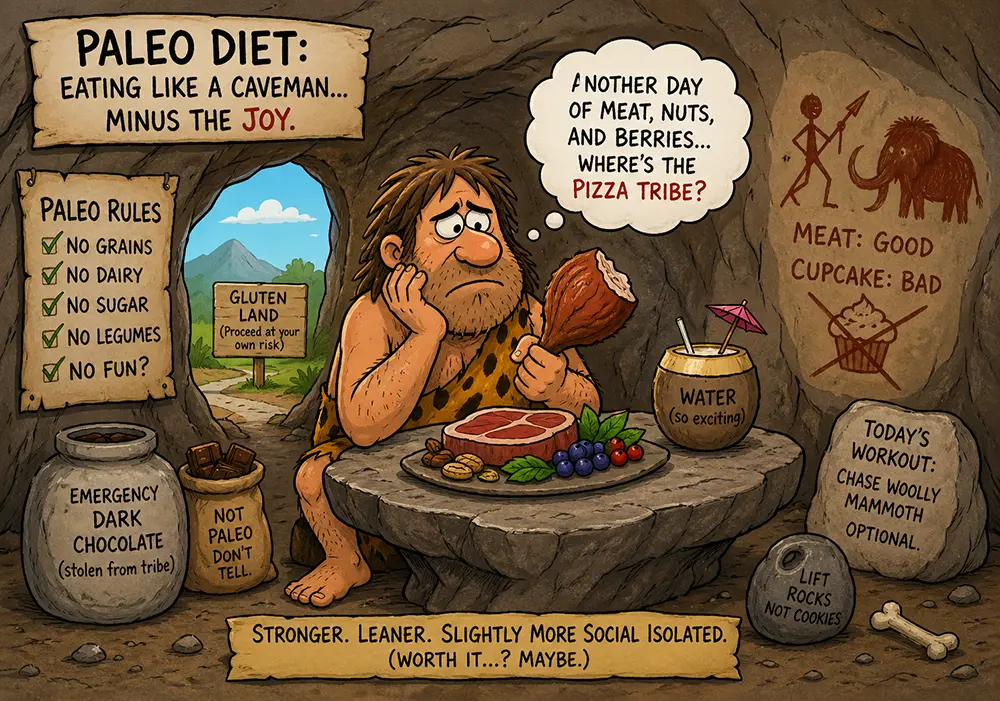
The Paleo diet is based on eating only foods that our ancestors in Paleolithic times would have eaten, some 12,000 years ago before the advent of agriculture. It argues that humans evolved to thrive on hunter-gatherer foods, while agriculture and modern processed foods arrived too recently for our biology to fully adapt. The diet permits meat, fish, fruit, most vegetables, nuts, and plant-based oils, such as olive and avocado oils. The diet specifically excludes dairy, grains, cereals, legumes (beans, peanuts), processed oils, processed sugar, alcohol, and coffee. The “rationale” behind this diet does not hold water for several reasons. Even so, there are beneficial aspect to the diet.
Evolution Did Not Design Humans for a Particular Diet
One serious flaw is the Paleo diet’s assumption that evolution “designed” us to be an ideal match for our environment and diet 12,000 years ago. This is completely wrong. Evolution doesn’t “design” anything, all it does is favor the continuation of genes that are associated with leaving more offspring. Thus, a caveman who was sickly and died at 25, but left 12 children, was an evolutionary success and his genes would continue in the population. In contrast, another caveman who lived a healthy life to the age of 60, but left only 1 or 2 children, was not a success in evolutionary terms. In other words, the notion that Paleolithic folks were ideally adapted to their diet is false. As long as their diet allowed them to leave children, that was enough.
Our Ancestors Ate More Foods Than the Diet Claims
A second serious flaw is the diet’s assumptions about what foods people did and did not eat back then. There is, for example, quite a bit of evidence that Paleolithic humans ate grains and legumes, but these foods are forbidden by the diet. There is also evidence that humans were cooking and eating tubers and other starchy vegetables as far back as 300,000 years ago. Most Paleo humans did not eat peppers, tomatoes, avocados, potatoes, pineapple, or blueberries (among others) because these are new world plants that were not available to the large majority of humans during Paleolithic evolution. Yet the Paleo diet allows them all. Dietary flexibility was a hallmark of humans and one reason for our evolutionary success—we did not evolve to eat certain specific foods; we evolved to eat pretty much anything. Would anyone care to argue that Paleolithic humans in the sub-arctic zones, the rain forest, the plains, and the temperate coastal regions ate the same or even similar diets? I don’t think so.
Human Genetics Can Change Quicky
Paleo diet diet proponents falsely claim that human genetics have not changed in any meaningful way since Paleolithic times and therefore the human digestive and metabolic systems cannot have adapted to deal with “new” foods. This is no true. It is well documented that human genes have changed in response to the introduction of dairy into the diet and to the development of agriculture, with the greater availability of wheat and other grains. While on the subject of genetics, it's impossible to understand why humans have multiple copies of the gene for amylase, an enzyme whose sole purpose is digesting starches, if starchy foods had not been an important part of the human diet for a long time.
Paleo Humans Died Young
Before being impressed by the Paleo diet, you might want to consider the fact that the life expectancy of humans in Paleolithic times was somewhere in the mid-30s. Is theirs the diet you want to eat? Of course, many other factors have contributed to the increase in life expectancy, including improvements in medicine, public health, and nutrition. Oh wait, did I say nutrition? You know, like eating foods the Paleo diet does not permit, such as grains, legumes, and dairy?
Is the Paleo Diet Healthful?
Yes, in many ways the Paleo diet is healthful. It emphasizes natural foods and avoids overly processed foods and excess carbs and sugar. Many people have successfully used Paleo to lose weight and feel better. But there's nothing new or unique about these ideas, they are central to many other diet plans such as Atkins and Keto. Folks should be aware that the rationale behind the diet is flawed, there's nothing particularly "Paleolithic" about it!
You Might Enjoy These Myths
No, green tea does not promote weight loss.
For most folks, protein supplements are pointless.