
This is false. Foods labeled "no added MSG" can still contain MSG that was added as part of another ingredient. This is deceptive but legal.
CORRECTION
My original version of this post was in error, as has been pointed out by a reader (see the comments). I had claimed that food labeled “No Added MSG” could still contain MSG that had been added as part of another ingredient, such as hydrolyzed soy protein (HSP). This is not true; the label “No Added MSG” does not permit HSP or other ingredients that themselves contain free glutamate. My apologies for the error.
About MSG and Health
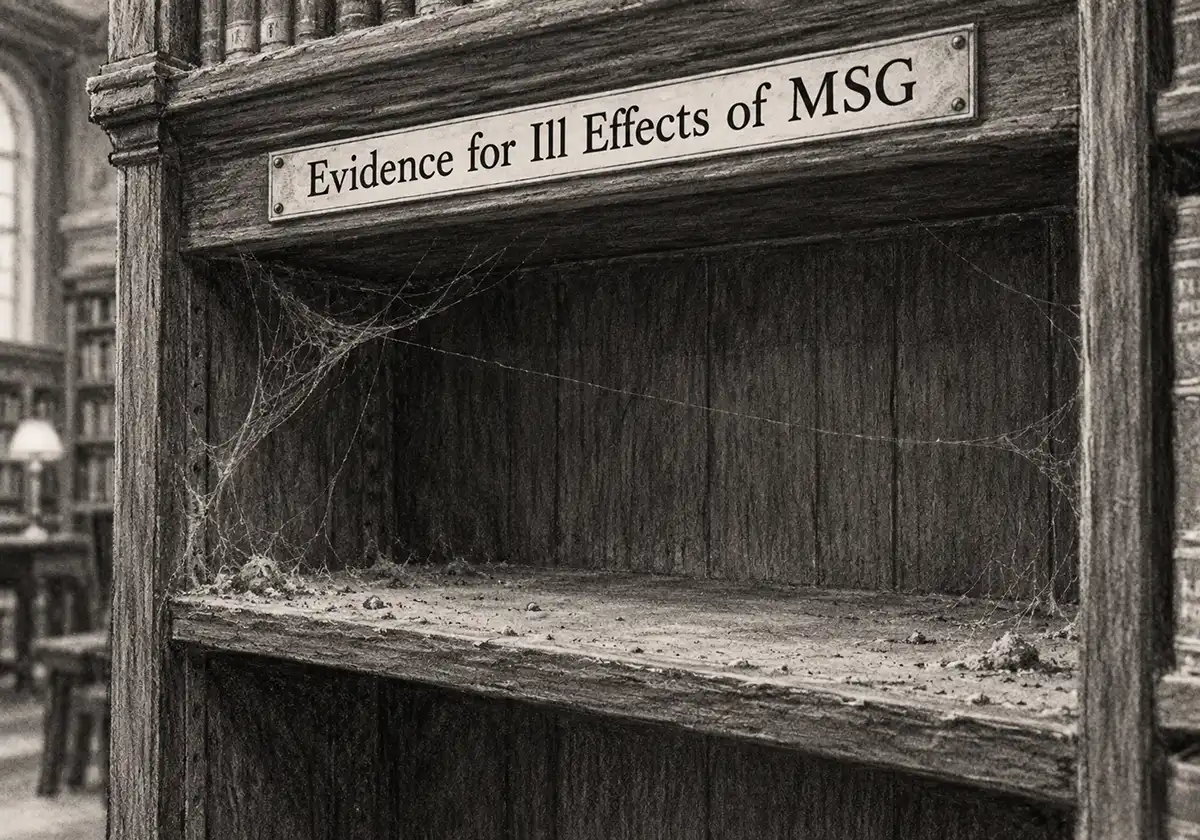
Why is it that manufacturers want to present their food as being free of MSG? It is because some people want to avoid MSG, but the fact is that the fear of MSG is a total fantasy with no basis in fact—precisely zero legitimate evidence. And some claim to get "Chinese restaurant syndrome" from MSG, a phenomenon that seems to be purely psychological. Click this link to read more about MSG and health.
Some Other Health-Related Posts for You!
For 95% of people, gluten is perfectly fine with no health risks.
No, seed oils are not a health risk. That claim is 100% bogus.


The FDA page you link answers this against the post. From it: foods with ingredients naturally containing free glutamate, including hydrolyzed vegetable protein, autolyzed yeast, yeast extract, soy extracts and protein isolate, “cannot claim ‘No MSG’ or ‘No added MSG’ on their packaging.” That is the exact scenario in the post, and FDA says it is not allowed. 21 CFR 101.22(a)(5) says it from the other side: MSG used as an ingredient must be declared as monosodium glutamate.
The ingredients-of-ingredients carve-out (101.22(a)(2), via 101.100(a)(3)) is real, and it is why cheese need not list milk. My read only: it does not cover HSP, because 101.100(a)(3) exempts incidental additives only at insignificant levels with no technical or functional effect. HSP is added for umami. Functional effect, so the carve-out fails.
One smaller thing: “precisely zero legitimate evidence” is stronger than FDA’s own wording, which is “we were never able to confirm.” Geha 2000 (J Allergy Clin Immunol 106:973, PMID 11080723) found 5 g MSG without food beat placebo on symptoms in self-identified reactors, 38.5% vs 13.1%, but not reproducible on retest and no persistent or serious effects. So no reproducible harm at ordinary intake, yes. Zero evidence of any symptom, no. The 0.55 g vs 13 g scale point is the half I would keep.
Thank you for the heads up on HSP! I have corrected the post. Much appreciated.